
IDEX Online Research: Inflation Pace for Jewelry Slows in January
February 23, 09
The Federal Reserve Bank of the U.S. has been worried about potential deflation, especially if this recessionary environment persists. Even the Consumer Price Index (CPI) numbers in the second half of 2008 suggested that deflation was a distinct possibility.
After being flat (no inflation or deflation) in August and September of 2008, prices fell in October, November, and December. However, in January, the inflation rate for all commodities in the U.S. rose by 0.3 percent for the month, or a 3.6 percent annual rate. Further, virtually all of the major categories showed price inflation – food, shelter (housing), energy, apparel and transportation. Rising prices generally signal a solidifying economy.
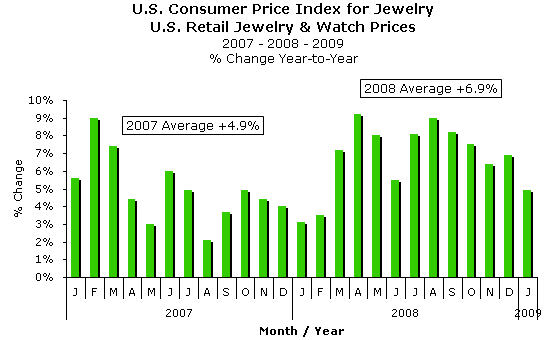
Jewelry was one of those categories which helped push up inflation. In January, retail prices for jewelry and watches rose by 4.9 percent on an annual basis. While this inflation rate was above the national inflation rate, it represents a moderation from last year’s peak of 9.2 percent in April, followed by another spike up to 9.0 percent in August. In short, a trend line of the inflation rate for jewelry at retail would suggest that inflation will continue to moderate in 2009.
Here’s the summary of inflation at the jewelry retail and supplier level for the month of January 2009, as expressed as a percentage change year-over-year (January 2009 versus January 2008) in the U.S. market:
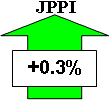
- Jewelry Producer Price Index +0.3%
- Precious Metals for Jewelry (1.0%)
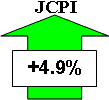
- Jewelry & Watch Consumer Price Index +4.9%
- Jewelry CPI +5.2%
- Watch CPI +2.8%
Outlook: Moderating Jewelry Price Inflation
It is highly unlikely that there will be any significant inflation at the producer level for jewelry in 2009. Demand is weak, and commodity prices, while fluctuating, are not expected to rise significantly, based on consensus forecasts.
At the retail level, the inflation number should moderate later in the second quarter. By the end of the second quarter of 2008, most U.S. jewelers had implemented higher retail pricing due to higher prices from their suppliers. Thus, comparisons in the first few months of 2009 versus the same period in 2008 reflect “old pricing” in 2008 versus “new higher prices” in 2009.
In subsequent months in the second half of 2009, retail prices will be compared to the higher prices which were implemented in the second half of 2008. Since there have been no material retail price increases since mid-2008, inflation at the retail level in the U.S. market should be more or less flat. Even when demand recovers, we don’t look for any significant retail price increases. Merchants are going to be cautious before they implement new higher prices which might scare off their loyal customers.
Jewelry Producer Price Index (JPPI) +0.3% in January
 |
As a result, jewelry suppliers are offering a variety of price-based incentives to move merchandise into retailers’ stores. These price-based incentives are reflected in the modest inflation rate at the jewelry supplier level.
There is still a backlog of high-cost goods in the distribution pipeline that suppliers need to pass on to their customers. But the good news is that the pressure is off – suppliers’ costs have moderated, so they aren’t being forced to continue to raise prices in the face of a weakening environment of consumer demand.
We believe that suppliers will likely hold off on any significant price increases near term for one key reason: retail jewelers simply won’t accept higher prices in the current recessionary environment.
Further, because the wholesale community is so fragmented, no one supplier has pricing power. We’ve seen some panic pricing by suppliers who are trying to move goods – at a loss, if necessary – to raise cash. In that kind of environment, any supplier who tries to raise prices will lose business.
The following graph summarizes the monthly Jewelry Producer Price Index for inflation since early 2007. The percentage figures are based on year-to-year comparisons of the BLS Jewelry Producer Price Index.
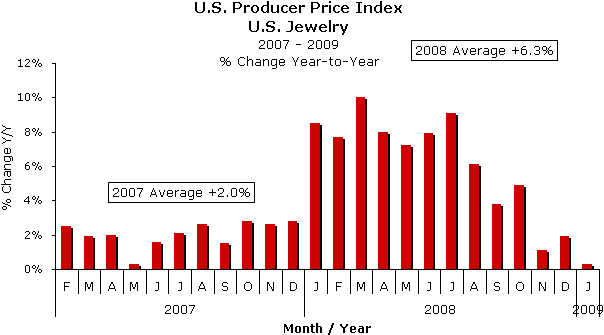
Source: BLS
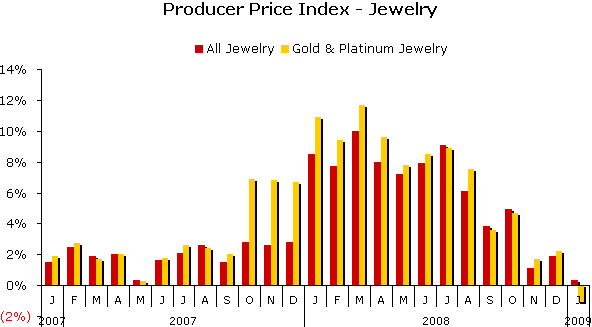
Why is the Jewelry Producer Price Index decelerating? Prices for both precious metal jewelry and gemstone jewelry have moderated. The graph below compares the JPPI (red bars) to inflation for precious metals (gold bars); gold had been the primary driver of precious metals inflation, before backing off later in 2008. However, in recent weeks, the price of gold has begun to rise again. We believe this is due to demand for gold as a replacement for shaky currencies around the globe. In a recessionary period, gold is a safe harbor for disillusioned investors who may have held equities, debt and currencies.
As the graph below illustrates, precious metals jewelry prices at the supplier level showed deflation in January. Prices were down 1.0 percent.
Source: BLS
We note, further, that producer price inflation in January – +0.3 percent – was dramatically below the retail price inflation rate for the entire jewelry category of +4.9 percent. Early in 2008, producer prices in the precious metals category rose more than the corresponding retail prices. As a result, retailers raised their prices in the second quarter of 2008. These trends illustrate the lag effect – 3-5 months – between rising producer prices and the resultant rising retail prices.
Jewelry Consumer Price Index (JCPI) +4.9 percent in January
 |
For the full year, retail price inflation for jewelry in the U.S. market ran at an annual rate of +6.9 percent, a pace it has maintained for the past several months. Now, however, it appears that jewelry price inflation will moderate in the coming months, especially as we anniversary the price increases that jewelers implemented in the second quarter of 2008.
While there was some price inflation volatility on a month-to-month basis during 2008, the trend for the past several months is quite clear: jewelry price inflation at the retail level is moderating, though it is still running well ahead of its two-decade annual gain of about +1.6 percent.
The graph below summarizes the percentage change in retail prices of jewelry and watches by month on a year-to-year basis since 2007. The percentage change is based on a comparison to the same month a year ago (January 2009 versus January 2008).
Source: BLS
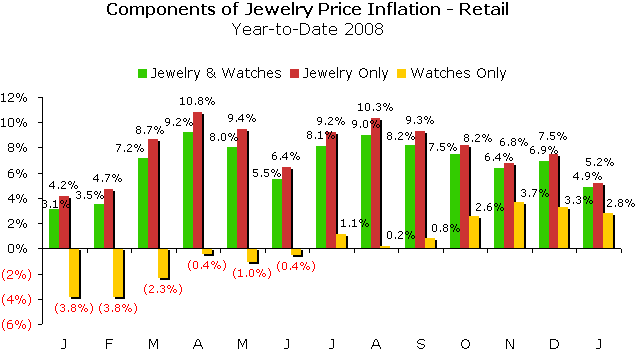
Early in 2008, the components of jewelry and watch price inflation at the retail level reflected a disparity in price increases. Jewelry retail prices were up consistently during the first half of 2008, but watch retail prices showed virtually no price inflation until later in the year.
However, for the past two months, watch price inflation has moderated. There were several factors which contributed to inflationary pricing trends of watches in the second half of 2008, including the following:
- Mechanical watch mechanisms from Switzerland have been in short supply due to manufacturing capacity constraints.
- Demand for high-end watches and branded watches was relatively strong prior to the holiday selling season, according to retail jewelers.
However, during the holiday selling season, demand for high-end watches was generally weak at retail. In particular, jewelers told us that Rolex watches sat in their showcases, and consumers didn’t ask for this prestigious brand in the current recessionary environment. Our forecast calls for significantly moderating price inflation for watches in 2009 – in fact, price deflation will likely occur, in our opinion.
The graph below illustrates the JCPI consisting of both jewelry and watch prices (green bars), jewelry prices only (red bars), and watch prices (yellow bars).
Source: BLS
Outlook: Possible Price Deflation in 2009
After rising by nearly 7 percent in 2008, we are forecasting price deflation for jewelry in 2009 at the supplier level. Our current prediction calls for 2009 price deflation to be in the low single digit level, but because it is so early in the forecast cycle, we’d call this little more than an educated guess tempered by historical trends.
At the retail level, there will likely be little or no core inflation pressure. However, because of higher prices in early 2009 versus the same period in 2008 when prices were significantly lower, we may see price inflation for the year, though it will be more a trick of math rather than real inflation.