
IDEX Online Research: Less Jewelry Firm Closures in H1 2010
July 28, 10
For the first six months of 2010, the U.S. jewelry industry lost only 48 retail jewelry firms versus a loss of 300 firms for the first six months of 2009, according to newly released data from the Jewelers Board of Trade (JBT). We view this as good news: the recession-driven exodus of American jewelers has finally tapered to a dribble.
The news is similarly positive at the wholesale and supplier leve. For the first six months of 2010, the number of U.S. jewelry wholesalers exiting the business dropped by half: a net of 44 firms closed this year versus 88 closings in the same period last year. Among U.S. jewelry manufacturers, a net of 32 firms have closed this year through June, down from last year’s 45 closings for the same six-month period.
At the end of June 2010, the JBT jewelry census numbers stood as follows:
| Category of Jewelers | Number of Firms |
| Retailers | 22,134 |
| Wholesalers | 4,312 |
| Manufacturers | 3,190 |
It is important to note that JBT counts jewelry “firms.” Thus, Zale and Kay, both large chains with many stores, count as only one each in the census.
New Store Openings Improve
For the first six months of 2010, the number of new jewelry firm openings in the U.S. market increased compared to the same period a year ago. This year, 103 new jewelry firms opened, up from 91 in the first six months of 2009. While this year’s openings are still well below the 180 jewelers who opened in the first six months of 2004, the trend has finally reversed from the decline in new store openings that characterized the past six years.
Jewelry wholesalers and suppliers were much more cautious: fewer merchants opted to enter the U.S. jewelry industry this year than last year. There were 17 new jewelry wholesalers during the first six months of 2010 versus 20 new firms last year. The manufacturers experienced a similar ratio: 12 new supplier firms opened during the first six months of 2010 versus 15 new firms last year in the same period.
These statistics do not surprise us: retailers typically drive the need for more suppliers – both wholesalers and manufacturers. Now that the number of jewelry retail closings has slowed, and the number of new firms risen, we would expect a rise in the number of suppliers to begin to show a turn-around in the next twelve to twenty-four months.
U.S. Jewelry Bankruptcies Slow Dramatically
The number of retail jewelers in the U.S. market who filed for bankruptcy in the first half of 2010 fell to 26 firms versus 45 firms for the same period a year ago, according to the JBT.
Jewelry suppliers – both wholesalers and manufacturers – showed similar trends. Only one jewelry wholesaler filed for bankruptcy in the first six months of 2010 versus eight in the first half of last year. Among jewelry manufacturers, eight filed for bankruptcy versus ten a year ago in the first six months.
U.S. Jewelry Industry Financial Health Improves
There was improvement in virtually every category of financial health that the JBT reports. Credit ratings for retail jewelers improved for the first six months of 2010. The number of vendor claims for retailers’ unpaid bills fell, and the average size of the unpaid bill fell.
The table below summarizes major measures of U.S. jewelry retailers’ financial health.
| Financial Measure | H1 2010 | H1 2009 |
| Ratings Changes – Increase | 4,470 | 4,043 |
| Ratings Changes – Decrease | 3,989 | 4,966 |
| Number of Claims | 1,202 | 1,905 |
| Average Claim | $7,126 | $9,036 |
Final 2009 BLS Data Shows Large Decline in U.S. Jewelry Doors
The U.S. Bureau of Labor Statistics provides a census of jewelry “doors” in the U.S. This data is based on those stores (physical store locations, not firms) which provide quarterly employment data. Unfortunately, not all jewelry stores are required to file quarterly data, so the number of doors is larger than the numbers provided by the Bureau of Labor Statistics (BLS). However, we watch trends in the number of doors, rather than trying to reconcile the BLS numbers with either the JBT or the U.S. Census Bureau numbers.
Because the BLS data lags by about six months, preliminary data on total jewelry doors for the fourth quarter of 2009 have just been published.
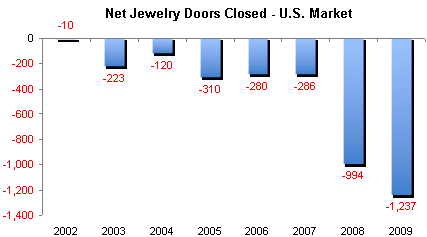
The graph below illustrates the decline in the number of jewelry doors in the U.S. by year, based on changes in fourth quarter year-over-year numbers. Previously, IDEX Online Research had used the average number of store doors by year; we now believe that the fourth quarter comparisons provide a tighter snapshot and better approximation of actual door closings in the U.S. market.
Clearly, the impact of the loss of Whitehall, Friedman’s, Bailey Banks & Biddle and others can be seen in the 2008 and 2009 figures.
Source: BLS
According to the Bureau of Labor Statistics, the number of jewelry doors (mostly stores, but also includes some kiosks and some leased departments) in the U.S. market at the end of the fourth quarter are shown by year on the table below.
| Year | Jewelry Doors |
| 2002 | 26,978 |
| 2003 | 26,755 |
| 2004 | 26,635 |
| 2005 | 26,325 |
| 2006 | 26,045 |
| 2007 | 25,759 |
| 2008 | 24,765 |
| 2009 | 23,528 |
Reconciliation between BLS and JBT Data
According to the JBT data, there were 22,182 jewelry firms in the U.S. market at the end of 2009. According to BLS data, there were 23,528 jewelry doors in the U.S. market at the end of 2009. Thus, there were 1,346 more doors than firms.
However, according to National Jeweler’s “State of the Majors” (published May 16, 2010), America’s top fifty specialty jewelers operated just over 5,400 stores during 2009. Those top 50 jewelers all have eight stores or more (eight stores happens to be the break-point for the Top Fifty list this year; previously the break-point was ten stores). We also note that as recently as 2006, the top fifty U.S. specialty jewelers operated more than 7,000 stores.
Based on an analysis of this data, the BLS is missing at least 5,500 jewelry doors, and perhaps as many as 6,000 doors. Based on the BLS reporting requirements, this is no surprise.
However, there are also differences in the definitions used by the JBT as well as the various government agencies charged with toting the census numbers.
As a researcher, we like numbers to “cross and foot.” But long ago, we determined that given the scarcity of data on the U.S. jewelry industry, it was highly unlikely that data would cross and foot tightly. That’s why we look much more closely at data trends than actual numbers.
We are most comfortable with JBT data. We believe that their estimate of just over 22,000 U.S. jewelry firms is accurate. The number of jewelry doors is a bit more problematic: we believe that the number may be between 27,500 and 28,000, based on the latest data as well as recent store closings.
The U.S. Census Bureau, our third source for jewelry census data, has indicated that its numbers for 2008 should be available shortly, and 2009 data will be available sometime in late 2011. The Census Bureau numbers tend to be about 10 percent higher than BLS numbers. Thus, we would expect those numbers to show 25,500 to 26,000 doors at the end of 2009. Unfortunately, that’s still about 2,000 or so doors below what we believe to be the actual number of U.S. jewelry doors.
Still, the trends of all three sources of jewelry census data show the same thing: the number of doors and firms in the U.S. market continues to decline.
Based on a new analysis of the latest data, our current mid-2010 census for U.S. jewelry retailers is shown on the table below:
| U.S. Jewelers | Number |
| Jewelry Firms (Chains count once) | 22,000 |
| Jewelry Doors (Stores & locations) | 27,500 |